An EMC radiated immunity system may need to generate controlled RF fields from tens of megahertz to several gigahertz. One of the main design decisions is whether to use a single broadband RF power amplifier or divide the required frequency range between multiple amplifiers operating in separate bands.
Both approaches can support radiated immunity testing, but they differ significantly in available output power, efficiency, system complexity, cost, maintenance, and future expansion.
The correct choice depends on the required test standard, field strength, antenna system, chamber size, and how much RF power is needed at the most difficult frequencies.
A typical IEC 61000-4-3 radiated immunity test system includes a signal generator, RF power amplifier, directional coupler, transmitting antenna, field probe, chamber, and test control software. The amplifier architecture should be selected together with these components rather than independently.

What Is a Broadband RF Power Amplifier?
A broadband RF power amplifier covers a relatively wide frequency range with one amplifier.
The main advantage is simplicity. Instead of switching between several amplifiers during a frequency sweep, the test software can continue using the same RF path across a larger part of the immunity test range.
This can reduce:
* RF switching
* Rack space
* Control complexity
* Interconnection cables
* Calibration transitions
* Number of amplifier models to maintain
For EMC laboratories performing moderate field-strength testing, a broadband amplifier can provide a compact and convenient solution.
However, wide frequency coverage often involves a trade-off. A broadband amplifier may not provide the same output power or efficiency across its complete operating range.
The lowest available output at the most difficult frequency can determine whether the amplifier is suitable for the test.
What Is a Multi-Band Amplifier System?
A multi-band EMC immunity system divides the required frequency range between two or more RF power amplifiers.
For example, separate amplifier sections may be used for:
* Lower VHF and UHF frequencies
* 1 GHz to several gigahertz
* Higher microwave frequencies
Each amplifier is optimized for a narrower frequency range.
This usually allows the system to provide more usable RF power in each band compared with one amplifier attempting to cover the entire range.
An RF switch matrix or automated controller selects the appropriate amplifier as the test frequency changes.
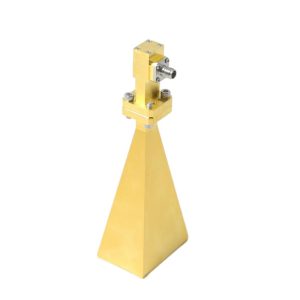
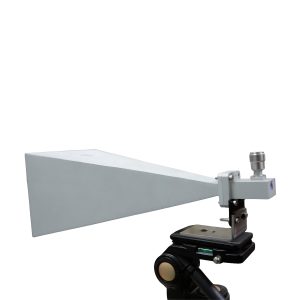
The same approach is often used with EMC antennas. A lower-frequency biconical or log-periodic antenna may be combined with a higher-frequency dual-ridged horn antenna.
Frequency Coverage vs. Available Power
The most obvious advantage of a broadband amplifier is frequency coverage.
A single unit can simplify testing across a large range, but frequency coverage alone is not enough.
The key specification is:
How much usable output power is available at every required frequency?
An amplifier may be marketed as covering a very wide band while producing significantly less power near one end of the range.
This matters because radiated immunity systems are normally limited by the worst frequency rather than the average condition.
At one frequency, the system may benefit from:
* High antenna gain
* Low VSWR
* Low cable loss
* High amplifier output
At another frequency, all four conditions may become less favorable.
A multi-band amplifier system allows additional power to be concentrated where it is actually required.
The article Common Signs of Insufficient RF Amplifier Power in EMC Testing explains how these weak frequency regions appear during field calibration.
Efficiency and Thermal Performance
High-power RF amplifiers generate heat.
When one broadband amplifier operates across a very wide frequency range, its efficiency can vary considerably with frequency. Some sections of the band may require the amplifier to operate close to maximum capability simply to achieve the required field strength.
A multi-band system can use amplifiers optimized for each range, which can improve:
* RF efficiency
* Thermal performance
* Continuous operating capability
* Power margin
* Component life
This becomes increasingly important for high-field-strength EMC immunity testing where amplifiers may operate for long periods during automated sweeps.
A system that reaches the target field during a short calibration but runs continuously near compression may experience output drift or thermal protection during the actual test.
System Complexity
Broadband amplifiers have a clear advantage in system simplicity.
A single amplifier may require only one main RF path between the signal generator and transmitting antenna.
A multi-band system may need:
* Several RF amplifiers
* RF input switches
* High-power output switches
* Additional directional couplers
* More RF cables
* Multiple control interfaces
* Separate calibration data for each path
This increases the number of components that must be configured and maintained.
Modern EMC software can automate amplifier and antenna switching, so the additional complexity does not necessarily increase operator workload during normal testing. It does, however, increase system engineering requirements.
For a small pre-compliance laboratory, simplicity may be more valuable than maximum power efficiency.
For a full compliance laboratory covering multiple standards and high test levels, the additional flexibility of a multi-band architecture may be more useful.
Relationship with EMC Antenna Selection
Amplifier and antenna frequency bands should be planned together.
The transmitting antenna determines how efficiently amplifier output is converted into electric field strength.
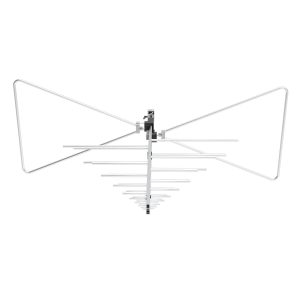
For example, the 1313-2-80M1G log-periodic antenna covers 80 MHz to 1 GHz and is intended for high-intensity field generation.
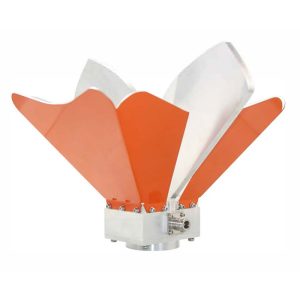
At higher frequencies, the OBH-08180 broadband dual-ridged horn antenna covers 0.8 GHz to 18 GHz and provides increasing directional gain across the microwave range.
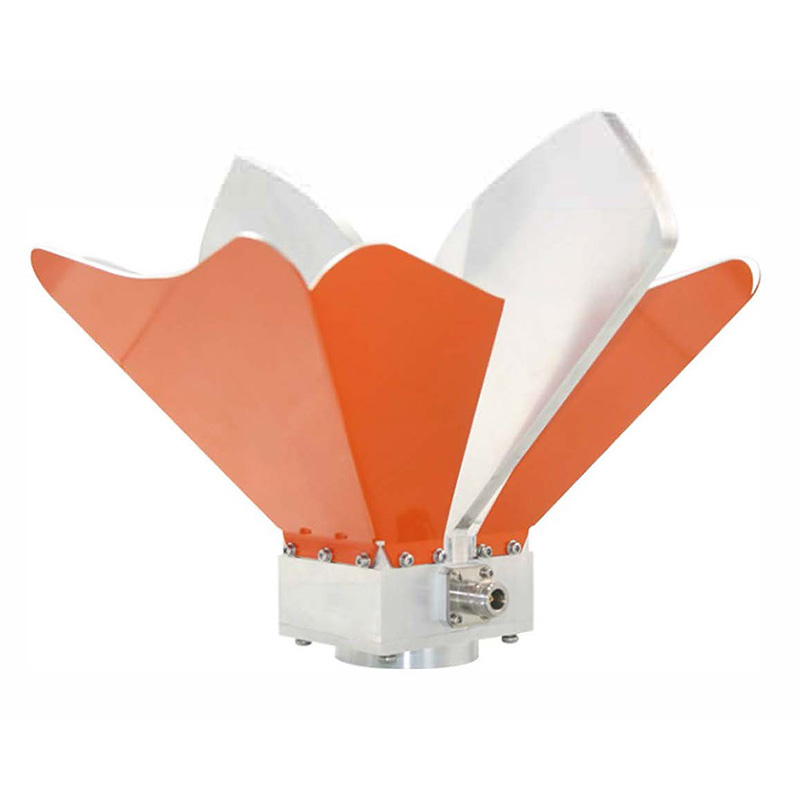
These antennas overlap in frequency, which gives the system designer some flexibility when selecting amplifier crossover points.
The crossover does not need to occur exactly at the end of an antenna’s specified frequency range.
Instead, it can be selected where the combination of:
* Amplifier output
* Antenna gain
* Antenna VSWR
* Cable loss
* Field uniformity
provides the most efficient field generation.
This is one reason broadband antennas can improve EMC test efficiency without necessarily eliminating the need for multiple RF amplifiers.
Power Margin and High-Field Testing
Multi-band amplifiers become more attractive as the required field strength increases.
Electric field strength increases with the square root of RF power. Generating substantially higher V/m levels can therefore require a large increase in amplifier power.
A broadband amplifier that is sufficient for 3 V/m or 10 V/m testing may not provide enough margin for higher immunity levels.
Using dedicated amplifier bands makes it easier to increase power only where necessary.
For example, if the system requires significantly more power below 1 GHz because of lower antenna gain, there is little benefit in purchasing the same high power capability across the entire microwave range.
The relationship between RF power, antenna gain, and test distance is explained in How Amplifier Power, Antenna Gain, and Test Distance Determine Field Strength.
Reliability and Maintenance
A broadband system contains fewer major RF components, which can simplify maintenance.
There are fewer:
* Amplifiers
* RF switches
* Interconnecting cables
* Control channels
* Cooling systems
However, one broadband amplifier also represents a larger single point of failure. If that amplifier is unavailable, a large part of the immunity test range may be unusable.
A multi-band system provides some operational separation. A failure in one amplifier band may still allow testing in other frequency ranges.
It also allows individual amplifier sections to be upgraded without replacing the complete amplification system.
For laboratories that expect test requirements to expand over time, this modularity can be useful.
Cost Should Be Evaluated at System Level
A single broadband amplifier may appear less expensive because fewer units are required.
But amplifier purchase price is only part of the system cost.
The complete comparison should include:
* Required RF output power
* High-power RF switches
* Cables and connectors
* Rack space
* Cooling
* Control hardware
* Calibration
* Maintenance
* Future frequency expansion
A very high-power broadband amplifier may be more expensive than two or three amplifiers optimized for narrower bands.
Conversely, for moderate test levels, the added switches and hardware required by a multi-band system may make a broadband amplifier more economical.
The best architecture is the one that achieves the required calibrated field with sufficient margin across the full frequency range.
When a Broadband Amplifier Makes More Sense
A broadband RF amplifier is generally more attractive when:
* The required field strength is moderate.
* Wide frequency coverage is more important than maximum power.
* Rack space is limited.
* Simple automation is preferred.
* The laboratory performs pre-compliance testing.
* Amplifier switching should be minimized.
* Power requirements are relatively consistent across the band.
When Multi-Band Amplifiers Make More Sense
A multi-band amplifier architecture is usually more suitable when:
* High field strength is required.
* The test covers a very wide frequency range.
* Power requirements vary significantly with frequency.
* Different antennas are already used for different bands.
* High operating margin is required.
* Future upgrades are expected.
* Full compliance testing is performed regularly.
* Continuous high-power operation is important.
In practice, many complete EMC immunity systems use a multi-band amplifier architecture combined with broadband antennas. This provides the power efficiency of frequency-specific amplification while limiting the number of antenna changes.
The final amplifier configuration should be based on actual field-strength requirements, antenna gain, VSWR, test distance, RF path loss, and chamber calibration rather than frequency coverage alone.