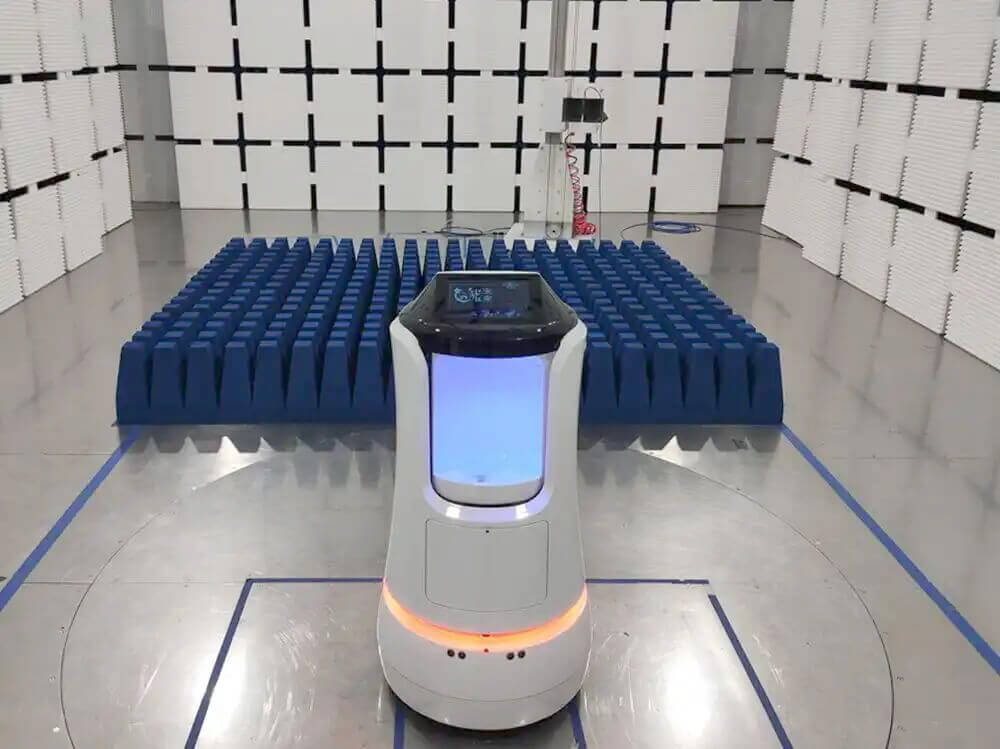
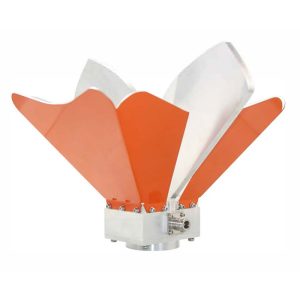
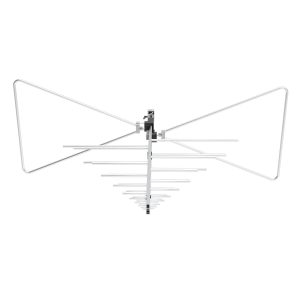
In EMC testing, antennas are not interchangeable tools. Each type is designed for a specific frequency range and measurement requirement, and the accuracy of radiated emission or immunity testing is closely related to the correct antenna selection. In practical EMC systems, biconical, log-periodic, and horn antennas are commonly used together to cover a wide frequency spectrum from low MHz to multi-GHz ranges.

Biconical Antenna: Low-Frequency EMC Measurement
Biconical antennas are mainly used in the lower frequency range, typically from 30 MHz to around 300 MHz, and in some cases extending up to 1 GHz depending on design. They are widely applied in radiated emission and immunity testing where low-frequency behavior needs to be captured.
At these frequencies, electromagnetic fields are more difficult to stabilize and often influenced by cable coupling and near-field effects. The biconical antenna provides relatively stable performance in this range and is often used during early-stage EMC evaluation and troubleshooting of switching power supplies, digital circuits, and general noise sources.

Log-Periodic Antenna: Broadband EMC Coverage
Log-periodic antennas are designed for wideband operation, commonly covering 200 MHz to 1 GHz or higher depending on the model. Their key advantage is consistent performance across a broad frequency range, which makes them suitable for scanning and system-level EMC measurements without frequent antenna replacement.
In radiated emission testing, this type of antenna is often used when evaluating devices with multiple noise sources distributed across different frequency bands. It is also widely applied in pre-compliance testing, where engineers need fast and efficient visibility of the overall emission profile.

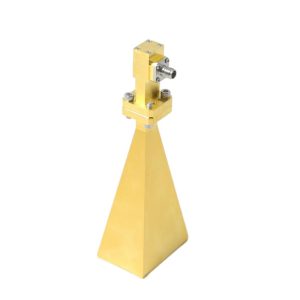
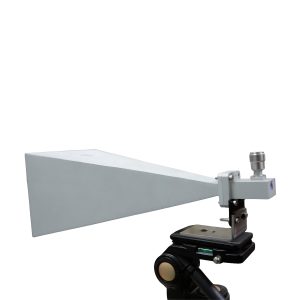
Horn Antenna: High-Frequency Precision Testing
Horn antennas are typically used in the higher frequency range, from around 1 GHz up to 18 GHz or beyond. They are characterized by high gain, strong directionality, and stable measurement behavior in far-field conditions.
This makes them particularly suitable for high-frequency radiated emission and immunity testing, as well as wireless device evaluation such as Wi-Fi, Bluetooth, and other RF modules. In controlled EMC chamber environments, horn antennas are commonly used where measurement stability and repeatability are critical.
Practical Selection Logic in EMC Systems
Across EMC testing setups, antenna choice is primarily determined by frequency coverage and test objectives. Low-frequency evaluation relies on biconical antennas, broadband scanning is typically handled by log-periodic antennas, and high-frequency measurements depend on horn antennas.
In most complete EMC test environments, these three antenna types are used together to ensure continuous coverage across the full required frequency range defined by international EMC standards.